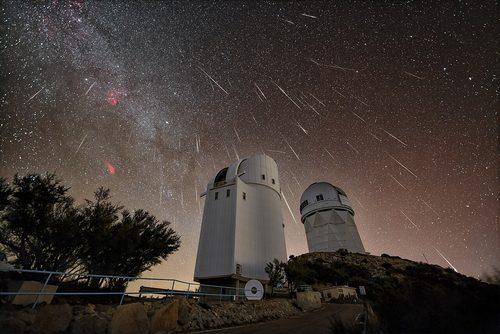
The Southern Taurids
Next peak: . The Moon will be 12% lit (waning crescent), a good year for this shower.
- Active
- 09/20 to 11/20 (month/day)
- Peak rate (ZHR)
- 7 per hour
- Radiant
- RA 52°, Dec +15°
- Speed
- 27 km/s (slow)
- Peak solar longitude
- 223°
- Parent body
- comet 2P/Encke
About the Southern Taurids
A long, low-rate shower of slow meteors spread through autumn, linked with Comet Encke. The Taurids are known for producing bright fireballs in some years, when Earth passes through a denser swarm of larger particles.
When and where to look. Visible most of the night because the radiant in Taurus is up from evening; best around midnight.
Best viewing on the peak night
| City | Night of | Best time (local) | Radiant height | Rough rate |
|---|---|---|---|---|
| London | Thu 5 Nov | 53° | up to ~6/h | |
| New York | Thu 5 Nov | 64° | up to ~6/h | |
| Los Angeles | Wed 4 Nov | 71° | up to ~7/h | |
| Singapore | Thu 5 Nov | 76° | up to ~7/h | |
| Sydney | Thu 5 Nov | 41° | up to ~5/h | |
| Cape Town | Thu 5 Nov | 41° | up to ~5/h |
Rough rate = ZHR × sine of the radiant altitude, at the darkest hour with the radiant highest. Light pollution and moonlight reduce it further.
Peak dates by year
| Year | Peak (UTC) | Moon |
|---|---|---|
| 2025 | 100% | |
| 2026 | 12% | |
| 2027 | 47% | |
| 2028 | 92% |
Computed as the moment the Sun reaches ecliptic longitude 223° (equinox J2000), the peak position in the IMO working list.