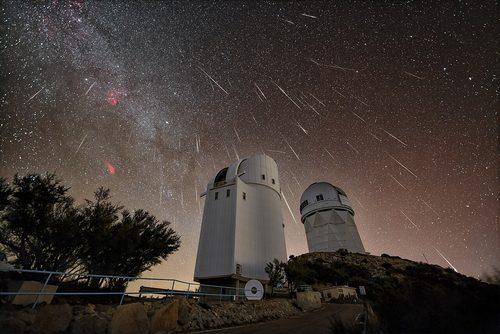
The Eta Aquariids
Next peak: . The Moon will be 0% lit (waxing crescent), a good year for this shower.
- Active
- 04/19 to 05/28 (month/day)
- Peak rate (ZHR)
- 50 per hour
- Radiant
- RA 338°, Dec -1°
- Speed
- 66 km/s (very fast)
- Peak solar longitude
- 45.5°
- Parent body
- comet 1P/Halley
About the Eta Aquariids
Debris shed by Halley's Comet over many returns meets Earth twice a year, and the Eta Aquariids in May are the first of the two encounters. The meteors are fast and often leave glowing trains. Because the radiant in Aquarius rises only a few hours before the Sun, this is a pre-dawn shower, and a much better one from the tropics and southern hemisphere than from mid-northern latitudes.
When and where to look. Look in the last two hours before morning twilight, facing east. From latitudes south of about 30° N the radiant climbs higher and rates are much better.
Best viewing on the peak night
| City | Night of | Best time (local) | Radiant height | Rough rate |
|---|---|---|---|---|
| London | Thu 6 May | 8° | up to ~7/h | |
| New York | Wed 5 May | 21° | up to ~18/h | |
| Los Angeles | Wed 5 May | 24° | up to ~20/h | |
| Singapore | Thu 6 May | 50° | up to ~38/h | |
| Sydney | Thu 6 May | 47° | up to ~36/h | |
| Cape Town | Thu 6 May | 44° | up to ~35/h |
Rough rate = ZHR × sine of the radiant altitude, at the darkest hour with the radiant highest. Light pollution and moonlight reduce it further.
Peak dates by year
| Year | Peak (UTC) | Moon |
|---|---|---|
| 2025 | 65% | |
| 2026 | 81% | |
| 2027 | 0% | |
| 2028 | 89% |
Computed as the moment the Sun reaches ecliptic longitude 45.5° (equinox J2000), the peak position in the IMO working list.