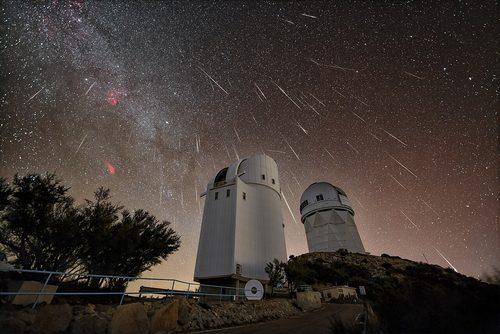
The Perseids
Next peak: . The Moon will be 87% lit (waxing gibbous), which will wash out all but the brightest meteors.
- Active
- 07/17 to 08/24 (month/day)
- Peak rate (ZHR)
- 100 per hour
- Radiant
- RA 48°, Dec +58°
- Speed
- 59 km/s (fast)
- Peak solar longitude
- 140.0°
- Parent body
- comet 109P/Swift-Tuttle
About the Perseids
The most watched meteor shower of the year: warm August nights in the northern hemisphere, high rates, and many bright, fast meteors with persistent trains. Rates build through early August and fall away quickly after the peak. The radiant in Perseus is circumpolar from much of Europe and North America, so some Perseids appear all night, with the best rates before dawn.
When and where to look. Northern hemisphere, any time after about 22:00 local time, best before dawn. The shower is poorly placed for most of the southern hemisphere.
Best viewing on the peak night
| City | Night of | Best time (local) | Radiant height | Rough rate |
|---|---|---|---|---|
| London | Thu 12 Aug | 65° | up to ~91/h | |
| New York | Thu 12 Aug | 63° | up to ~89/h | |
| Los Angeles | Thu 12 Aug | 61° | up to ~87/h | |
| Singapore | Fri 13 Aug | 33° | up to ~54/h | |
| Sydney | Fri 13 Aug | radiant never rises | ||
| Cape Town | Thu 12 Aug | radiant never rises |
Rough rate = ZHR × sine of the radiant altitude, at the darkest hour with the radiant highest. Light pollution and moonlight reduce it further.
Peak dates by year
| Year | Peak (UTC) | Moon |
|---|---|---|
| 2025 | 85% | |
| 2026 | 0% | |
| 2027 | 87% | |
| 2028 | 59% |
Computed as the moment the Sun reaches ecliptic longitude 140.0° (equinox J2000), the peak position in the IMO working list.