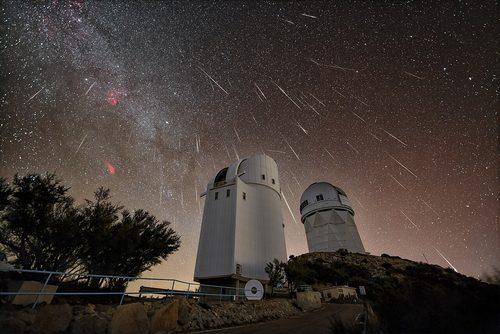
The Draconids
Next peak: . The Moon will be 67% lit (waxing gibbous).
- Active
- 10/06 to 10/10 (month/day)
- Peak rate (ZHR)
- 5 per hour
- Radiant
- RA 262°, Dec +54°
- Speed
- 20 km/s (slow)
- Peak solar longitude
- 195.4°
- Parent body
- comet 21P/Giacobini-Zinner
About the Draconids
Usually a quiet shower of very slow meteors, the October Draconids are famous for rare outbursts when Earth passes through a dense trail of debris from their parent comet, as happened in 1933, 1946, 2011 and 2018. Unlike most showers, the Draconids are best in the evening, because the radiant in the head of Draco is highest then.
When and where to look. Look in the evening, as soon as it is dark, from the northern hemisphere. Most years bring only a few meteors an hour.
Best viewing on the peak night
| City | Night of | Best time (local) | Radiant height | Rough rate |
|---|---|---|---|---|
| London | Fri 8 Oct | 66° | up to ~5/h | |
| New York | Fri 8 Oct | 64° | up to ~4/h | |
| Los Angeles | Fri 8 Oct | 59° | up to ~4/h | |
| Singapore | Sat 9 Oct | 28° | up to ~2/h | |
| Sydney | Sat 9 Oct | radiant up only in daylight | ||
| Cape Town | Fri 8 Oct | radiant up only in daylight |
Rough rate = ZHR × sine of the radiant altitude, at the darkest hour with the radiant highest. Light pollution and moonlight reduce it further.
Peak dates by year
| Year | Peak (UTC) | Moon |
|---|---|---|
| 2025 | 96% | |
| 2026 | 3% | |
| 2027 | 67% | |
| 2028 | 79% |
Computed as the moment the Sun reaches ecliptic longitude 195.4° (equinox J2000), the peak position in the IMO working list.