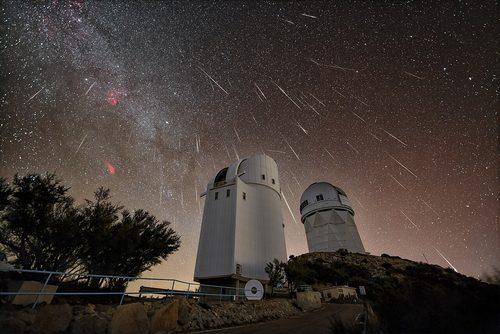
The Quadrantids
Next peak: . The Moon will be 12% lit (waning crescent), a good year for this shower.
- Active
- 12/28 to 01/12 (month/day)
- Peak rate (ZHR)
- 80 per hour
- Radiant
- RA 230°, Dec +49°
- Speed
- 41 km/s (fast)
- Peak solar longitude
- 283.15°
- Parent body
- asteroid 2003 EH1
About the Quadrantids
The year opens with one of the strongest showers and one of the hardest to catch. The Quadrantid peak is sharp, lasting only a few hours, so where you are on Earth when it arrives decides whether you see a good display or a thin one. The radiant sits in northern Boötes, near the handle of the Big Dipper, in a part of the sky once charted as the constellation Quadrans Muralis, which gave the shower its name.
When and where to look. Best from northern latitudes in the hours before dawn, when the radiant climbs high in the northeast. January nights are cold: dress for standing still, not for walking.
Best viewing on the peak night
| City | Night of | Best time (local) | Radiant height | Rough rate |
|---|---|---|---|---|
| London | Sun 3 Jan | 67° | up to ~74/h | |
| New York | Sun 3 Jan | 64° | up to ~72/h | |
| Los Angeles | Sun 3 Jan | 61° | up to ~70/h | |
| Singapore | Sun 3 Jan | 24° | up to ~33/h | |
| Sydney | Mon 4 Jan | radiant never rises | ||
| Cape Town | Sun 3 Jan | radiant never rises |
Rough rate = ZHR × sine of the radiant altitude, at the darkest hour with the radiant highest. Light pollution and moonlight reduce it further.
Peak dates by year
| Year | Peak (UTC) | Moon |
|---|---|---|
| 2025 | 16% | |
| 2026 | 100% | |
| 2027 | 12% | |
| 2028 | 44% |
Computed as the moment the Sun reaches ecliptic longitude 283.15° (equinox J2000), the peak position in the IMO working list.