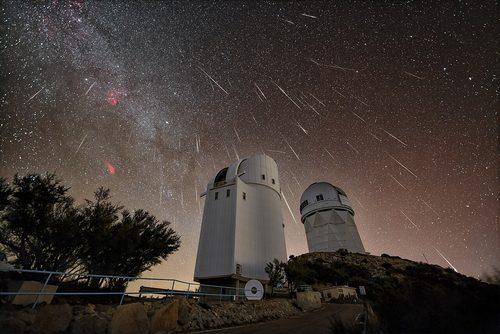
The Lyrids
Next peak: . The Moon will be 95% lit (waning gibbous), which will wash out all but the brightest meteors.
- Active
- 04/14 to 04/30 (month/day)
- Peak rate (ZHR)
- 18 per hour
- Radiant
- RA 271°, Dec +34°
- Speed
- 49 km/s (fast)
- Peak solar longitude
- 32.32°
- Parent body
- comet C/1861 G1 (Thatcher)
About the Lyrids
The April Lyrids are among the oldest showers on record, with observations going back more than two and a half thousand years in Chinese records. Rates are modest in most years, but the shower has produced occasional short bursts. Its radiant lies near Vega, the brilliant blue-white star of Lyra.
When and where to look. Watch after midnight once Vega is well up in the east; the hours before dawn are best. Northern hemisphere observers are favoured.
Best viewing on the peak night
| City | Night of | Best time (local) | Radiant height | Rough rate |
|---|---|---|---|---|
| London | Thu 22 Apr | 69° | up to ~17/h | |
| New York | Thu 22 Apr | 83° | up to ~18/h | |
| Los Angeles | Thu 22 Apr | 88° | up to ~18/h | |
| Singapore | Thu 22 Apr | 57° | up to ~15/h | |
| Sydney | Thu 22 Apr | 22° | up to ~7/h | |
| Cape Town | Thu 22 Apr | 22° | up to ~7/h |
Rough rate = ZHR × sine of the radiant altitude, at the darkest hour with the radiant highest. Light pollution and moonlight reduce it further.
Peak dates by year
| Year | Peak (UTC) | Moon |
|---|---|---|
| 2025 | 34% | |
| 2026 | 36% | |
| 2027 | 95% | |
| 2028 | 6% |
Computed as the moment the Sun reaches ecliptic longitude 32.32° (equinox J2000), the peak position in the IMO working list.