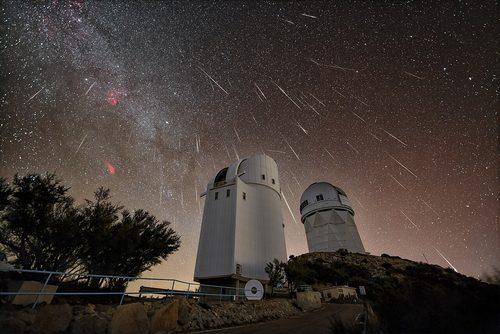
The Southern Delta Aquariids
Next peak: . The Moon will be 4% lit (waning crescent), a good year for this shower.
- Active
- 07/12 to 08/23 (month/day)
- Peak rate (ZHR)
- 25 per hour
- Radiant
- RA 340°, Dec -16°
- Speed
- 41 km/s (fast)
- Peak solar longitude
- 128°
- Parent body
- probably comet 96P/Machholz
About the Southern Delta Aquariids
A long, steady shower of July and August with a broad, gentle maximum. Its meteors are fainter on average than the Perseids that overlap with it, but from the southern hemisphere and the tropics, where its radiant in Aquarius rides high, it is a dependable summer-night companion.
When and where to look. Best from the southern hemisphere and the tropics, after midnight, with the radiant high in the south (north from southern latitudes).
Best viewing on the peak night
| City | Night of | Best time (local) | Radiant height | Rough rate |
|---|---|---|---|---|
| London | Sat 31 Jul | 22° | up to ~10/h | |
| New York | Sat 31 Jul | 33° | up to ~14/h | |
| Los Angeles | Sat 31 Jul | 40° | up to ~16/h | |
| Singapore | Sat 31 Jul | 73° | up to ~24/h | |
| Sydney | Sat 31 Jul | 72° | up to ~24/h | |
| Cape Town | Sat 31 Jul | 72° | up to ~24/h |
Rough rate = ZHR × sine of the radiant altitude, at the darkest hour with the radiant highest. Light pollution and moonlight reduce it further.
Peak dates by year
| Year | Peak (UTC) | Moon |
|---|---|---|
| 2025 | 39% | |
| 2026 | 96% | |
| 2027 | 4% | |
| 2028 | 74% |
Computed as the moment the Sun reaches ecliptic longitude 128° (equinox J2000), the peak position in the IMO working list.