
Venus this month
Venus is 7° from the Sun on 26 October 2026, too close to see in its glare. It shines at magnitude −4.2 in Virgo.
- Magnitude
- −4.2
- Constellation
- Virgo
- From the Sun
- 7° west
- Distance
- 0.27 AU (41 million km)
- Apparent size
- 61.1″
- Position
- RA 13h 41m, Dec -17.1°

Rise and set today in six cities
Local times on 26 October 2026. A planet that rises before sunset and sets after it is up in the evening; one that rises in the small hours is a morning object.
The year ahead
Angular distance from the Sun as seen from Earth. Inside the shaded band (15°) a planet is lost in twilight.
Coming events
- Greatest morning elongation: , 47.0° from the Sun
- Superior conjunction: (behind the Sun, not visible)
- Greatest evening elongation: , 46.1° from the Sun
- Inferior conjunction: (between Earth and the Sun, not visible)
- Greatest morning elongation: , 45.8° from the Sun
- Superior conjunction: (behind the Sun, not visible)
- Greatest evening elongation: , 47.0° from the Sun
Close approaches
- : the Moon and Venus 1.0° apart
- : the Moon and Venus 2.0° apart
- : the Moon and Venus 2.9° apart
- : Venus and Saturn 0.6° apart
- : Venus and Mars 0.3° apart
- : the Moon and Venus 0.9° apart
- : the Moon and Venus 2.9° apart
- : the Moon and Venus 0.9° apart
Seeing Venus
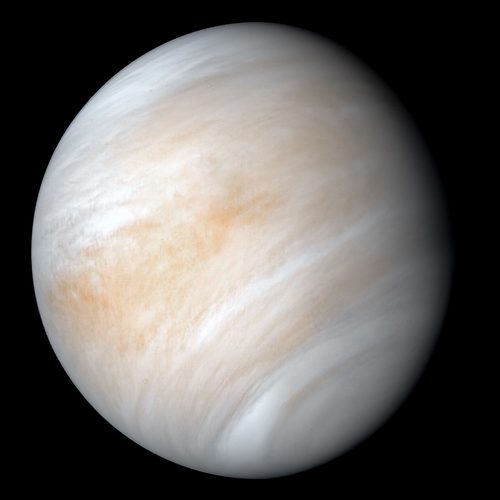
After the Moon, Venus is the brightest natural object in the night sky, bright enough to cast faint shadows from a dark site and often reported as a UFO. It is the 'evening star' for months at a time, then swings between Earth and the Sun to reappear as the 'morning star'. Through binoculars or a small telescope it shows phases like a small Moon.