
Jupiter this month
Jupiter is in the morning sky, 69° west of the Sun: look before dawn. It shines at magnitude −2.0 in Leo.
- Magnitude
- −2.0
- Constellation
- Leo
- From the Sun
- 69° west
- Distance
- 5.59 AU (836 million km)
- Apparent size
- 34.5″
- Position
- RA 9h 44m, Dec +14.3°

Rise and set today in six cities
Local times on 26 October 2026. A planet that rises before sunset and sets after it is up in the evening; one that rises in the small hours is a morning object.
The year ahead
Angular distance from the Sun as seen from Earth. Inside the shaded band (15°) a planet is lost in twilight.
Coming events
- Opposition: (opposite the Sun: up all night, closest and brightest)
- Conjunction: (behind the Sun, not visible)
- Opposition: (opposite the Sun: up all night, closest and brightest)
- Conjunction: (behind the Sun, not visible)
- Opposition: (opposite the Sun: up all night, closest and brightest)
- Conjunction: (behind the Sun, not visible)
Close approaches
- : the Moon and Jupiter 0.5° apart
- : Mars and Jupiter 1.2° apart
- : the Moon and Jupiter 1.1° apart
- : the Moon and Jupiter 1.4° apart
- : the Moon and Jupiter 1.4° apart
- : the Moon and Jupiter 1.1° apart
- : the Moon and Jupiter 0.9° apart
- : the Moon and Jupiter 0.9° apart
Seeing Jupiter
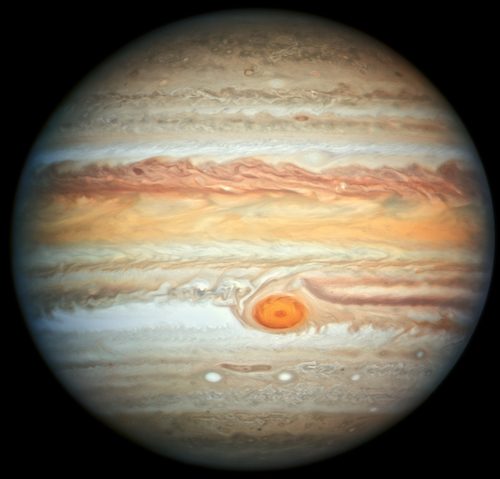
Jupiter is a brilliant, steady cream-white light, usually outshone only by Venus and the Moon. It spends about a year in each constellation of the zodiac. Even ordinary binoculars held steady show up to four of its largest moons, Io, Europa, Ganymede and Callisto, as tiny points in a line beside the planet, changing position from night to night.