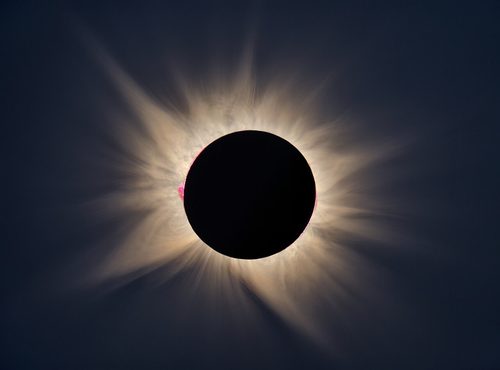
Total solar eclipse, Monday 25 November 2030
The Moon will completely cover the Sun along a narrow path across Botswana, S. Africa, Australia; a partial eclipse is seen over a much wider area: s Africa, s Indian Oc., E. Indies, Australia, Antarctica.
- Greatest eclipse
- Type
- Total
- Magnitude
- 1.047 (NASA 1.047)
- Gamma
- -0.3867
- Central duration (NASA)
- 03m44s
- Saros series
- 133
Where it is visible: our cities
| City | Maximum (local) | Magnitude | Sun covered | Sun altitude |
|---|---|---|---|---|
| Windhoek Namibia | total | 100% | 17° | |
| Johannesburg South Africa | 0.97 | 97% | 29° | |
| Brisbane Australia | 0.97 | 96% | -1° (low) | |
| Adelaide Australia | 0.92 | 91% | 14° | |
| Sydney Australia | 0.83 | 79% | 4° (low) | |
| Perth Australia | 0.81 | 77% | 34° | |
| Melbourne Australia | 0.79 | 75% | 11° | |
| Cape Town South Africa | 0.77 | 72% | 24° | |
| Alice Springs Australia | 0.76 | 71% | 13° | |
| Hobart Australia | 0.66 | 58% | 12° | |
| Antananarivo Madagascar | 0.52 | 41% | 48° | |
| Queenstown New Zealand | 0.44 | 33% | 0° (low) | |
| Port Louis Mauritius | 0.42 | 31% | 62° | |
| Darwin Australia | 0.41 | 29% | 10° | |
| Dar es Salaam Tanzania | 0.29 | 18% | 31° | |
| Nairobi Kenya | 0.16 | 8% | 26° | |
| Wellington New Zealand | 0.14 | 6% | -1° (low) | |
| Denpasar (Bali) Indonesia | 0.11 | 4% | 25° | |
| Lagos Nigeria | 0.04 | 1% | -1° (low) |
Magnitude is the fraction of the Sun's diameter covered at maximum; "Sun covered" is the fraction of its area. Computed for each city centre; a few kilometres can matter near the edge of a total or annular path.
Eye safety
Never look at the Sun without certified eclipse glasses (ISO 12312-2) or a pinhole projector, even when it is mostly covered. Only during totality itself is it safe to look with the naked eye.