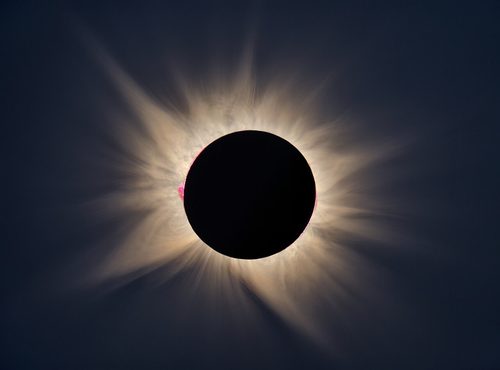
Partial solar eclipse, Tuesday 12 June 2029
A partial eclipse: the Moon's shadow axis misses Earth, so nowhere sees the Sun fully covered. Visible from Arctic, Scandanavia, Alaska, n Asia, n Canada.
- Greatest eclipse
- Type
- Partial
- Magnitude
- 0.463 (NASA 0.458)
- Gamma
- +1.2943
- Saros series
- 118
Where it is visible: our cities
| City | Maximum (local) | Magnitude | Sun covered | Sun altitude |
|---|---|---|---|---|
| Reykjavík Iceland | 0.40 | 28% | 1° (low) | |
| Yellowknife Canada | 0.38 | 26% | 3° (low) | |
| Tromsø Norway | 0.28 | 17% | 15° | |
| Fairbanks United States | 0.26 | 15% | 15° | |
| Oslo Norway | 0.25 | 14% | 6° (low) | |
| Edinburgh United Kingdom | 0.23 | 13% | -1° (low) | |
| Anchorage United States | 0.22 | 12% | 13° | |
| Stockholm Sweden | 0.21 | 11% | 8° (low) | |
| Copenhagen Denmark | 0.21 | 11% | 3° (low) | |
| Hamburg Germany | 0.20 | 10% | 0° (low) | |
| Helsinki Finland | 0.18 | 9% | 11° | |
| Berlin Germany | 0.17 | 8% | 1° (low) | |
| Amsterdam Netherlands | 0.16 | 8% | -1° (low) | |
| Prague Czech Republic | 0.14 | 6% | -1° (low) | |
| Warsaw Poland | 0.12 | 5% | 4° (low) | |
| Vienna Austria | 0.10 | 4% | -1° (low) | |
| Budapest Hungary | 0.08 | 2% | -1° (low) | |
| Moscow Russia | 0.06 | 2% | 14° | |
| Manchester United Kingdom | 0.05 | 2% | -1° (low) | |
| Munich Germany | 0.05 | 1% | -1° (low) | |
| Brussels Belgium | 0.05 | 1% | -1° (low) | |
| Kyiv Ukraine | 0.04 | 1% | 7° (low) |
Magnitude is the fraction of the Sun's diameter covered at maximum; "Sun covered" is the fraction of its area. Computed for each city centre; a few kilometres can matter near the edge of a total or annular path.
Eye safety
Never look at the Sun without certified eclipse glasses (ISO 12312-2) or a pinhole projector, even when it is mostly covered. Only during totality itself is it safe to look with the naked eye.