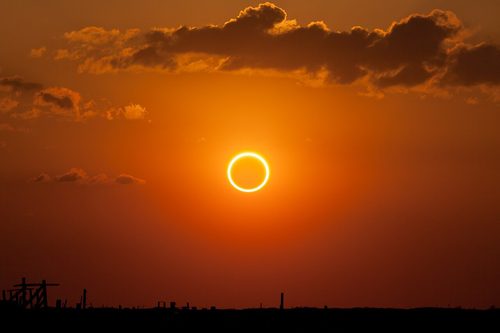
Annular solar eclipse, Saturday 6 February 2027
The Moon will be too far from Earth to cover the Sun completely, leaving a ring of sunlight, the "ring of fire", along a path across Chile, Argentina, Atlantic. A partial eclipse is seen over a wider area: S. America, Antarctica, w & s Africa.
- Greatest eclipse
- Type
- Annular
- Magnitude
- 0.928 (NASA 0.928)
- Gamma
- -0.2952
- Central duration (NASA)
- 07m51s
- Saros series
- 131
Where it is visible: our cities
| City | Maximum (local) | Magnitude | Sun covered | Sun altitude |
|---|---|---|---|---|
| Lagos Nigeria | annular | 84% | 0° (low) | |
| Accra Ghana | annular | 84% | 4° (low) | |
| Montevideo Uruguay | 0.92 | 86% | 70° | |
| Rio de Janeiro Brazil | 0.90 | 84% | 69° | |
| Buenos Aires Argentina | 0.88 | 82% | 69° | |
| São Paulo Brazil | 0.85 | 78% | 74° | |
| Santiago Chile | 0.71 | 62% | 59° | |
| Brasília Brazil | 0.67 | 58% | 72° | |
| Ushuaia Argentina | 0.64 | 53% | 46° | |
| La Serena Chile | 0.60 | 50% | 61° | |
| Dakar Senegal | 0.54 | 43% | 16° | |
| San Pedro de Atacama Chile | 0.45 | 33% | 70° | |
| La Paz Bolivia | 0.30 | 18% | 75° | |
| Windhoek Namibia | 0.25 | 14% | 3° (low) | |
| Las Palmas de Gran Canaria Spain | 0.21 | 11% | 8° (low) | |
| Marrakesh Morocco | 0.18 | 9% | 1° (low) | |
| Cusco Peru | 0.17 | 8% | 69° | |
| Manaus Brazil | 0.16 | 8% | 75° | |
| Casablanca Morocco | 0.13 | 5% | 0° (low) | |
| Johannesburg South Africa | 0.12 | 5% | -1° (low) | |
| Cape Town South Africa | 0.07 | 2% | 9° (low) | |
| Lima Peru | 0.07 | 2% | 60° | |
| Seville Spain | 0.03 | 1% | -1° (low) |
Magnitude is the fraction of the Sun's diameter covered at maximum; "Sun covered" is the fraction of its area. Computed for each city centre; a few kilometres can matter near the edge of a total or annular path.
Eye safety
Never look at the Sun without certified eclipse glasses (ISO 12312-2) or a pinhole projector, even when it is mostly covered. Only during totality itself is it safe to look with the naked eye.